
Hiyam’s story: reclaiming independence
December 3, 2025
More than a million people were forced to leave their homes during the conflict in Lebanon last year. Hiyam Zaatari, a 70-year-old mother of three adult children, was one of them. But once she found a new place to live, a lack of accessibility support left her confined there.
“When the war started, I lost everything,” Hiyam shared. “My home, my mobility and my son.” Hiyam was displaced in September 2024 and moved to a cramped, humid apartment on the fourth floor near the Ein El Helweh camp in Saida, South Lebanon.
Hiyam has an above-the-knee left leg amputation. Without access to appropriate mobility aids, she wasn’t able to leave her apartment or do basic tasks on her own.
“I never thought I would leave this apartment again,” she said. “We moved to this place because it was all we could find. But living here without a wheelchair was like being in prison.”
Hiyam described the physical and emotional toll of losing her mobility and independence. “I couldn’t even go to the toilet without help. I had no dignity left,” she recalled. “My body hurt constantly from lying on a hard bed. But worst of all, I couldn’t visit my son’s grave. He passed away years ago, and I felt like I had abandoned him.”
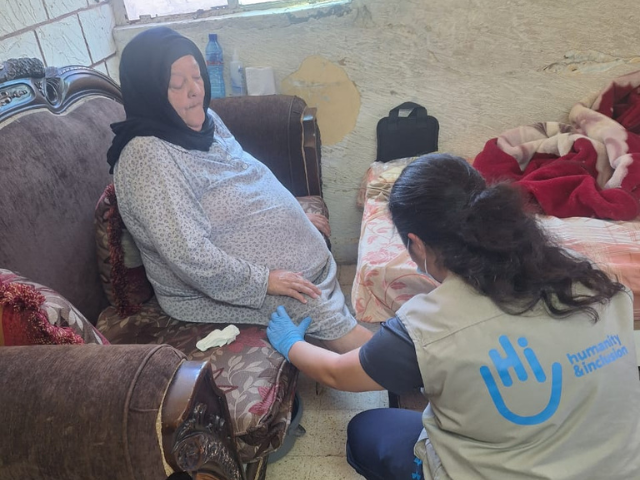
Following the Humanitarian Coalition’s Lebanon Emergency Appeal, with support from the Government of Canada, Humanity & Inclusion Canada was able to support Hiyam and 195 other patients with rehabilitation services, mobility aids and training for caregivers.
Hiyam received a wheelchair, a toilet chair and a medical mattress, as well as physiotherapy to help her use her wheelchair independently and reduce the risk of injuries. These supports were lifechanging – for the first time in years, Hiyam was able to move comfortably and even go outside.
“When they gave me the toilet chair, the mattress and the wheelchair, I cried,” Hiyam said. “I cried so much because, finally, I could do something by myself again. I could move, sleep better and breathe easier – and most importantly, I was able to visit my son’s grave again.”
Being able to visit her son’s grave was deeply meaningful. “I sat there, and I spoke to him. I told him I missed him. That moment gave me peace,” Hiyam said. She then expressed her gratitude for the rehabilitation program: “You gave me back something I had lost long ago, my freedom and my ability to grieve properly. Thank you for seeing me.”